Budo and Sport: Master Motonobu Hironishi Interviewed
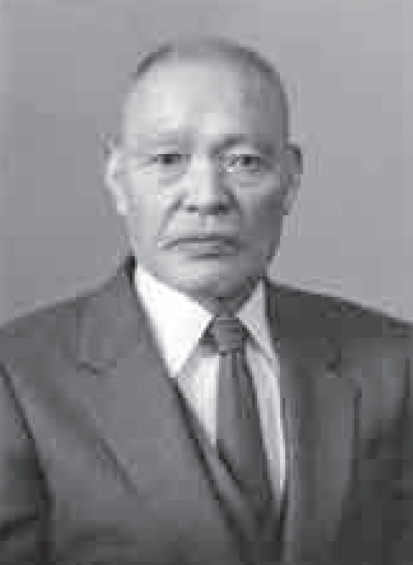
Master Motonobu (Genshin) Hironishi (1913 - 1999) • Direct disciple of Gichin Funakoshi, chief collaborator of Yoshitaka Funakoshi, and long-standing President of Nihon Karate-do Shotokai.
Motonobu (Genshin) Hironishi (1913 to 1999) was a direct disciple of Gichin Funakoshi. He gave a long interview to the bulletin of the Asociación Karate-do Shotokai de España, in Madrid. This page summarizes what he said. The views are his; the summary is ours, with a few short quotes.
His start in karate
Hironishi was born in Kyoto on January 1, 1913. He started karate in 1931, at nineteen, in the Waseda University karate club in Tokyo. Shigeru Egami and Hiroshi Noguchi were his closest seniors there; Funakoshi was the chief instructor, with Takeshi Shimoda as his assistant and, after Shimoda's early death, Funakoshi's third son, Yoshitaka.
He describes his friendship with Egami as an unspoken understanding that went beyond the dojo, present from the first days of training. He also mentions, with some amusement, that as a young man he was chosen in a national physique contest run by the Asahi Shimbun newspaper.
Funakoshi and Yoshitaka in person
His picture of Funakoshi is of a quiet, modest, gentle man, slightly below average height, who loved Chinese poetry and calligraphy. But in training, Hironishi says, his punches were devastating and his blocks very heavy, as the students found out whenever they attacked him.
Yoshitaka was different: passionate and formidable, a technical genius who stayed strictly orthodox, with a karate full of attacking initiative and energy.
Why Funakoshi banned competition
According to Hironishi, free sparring (jiyu kumite) was first developed as a research tool and for demonstrations. Over time it started drifting toward contests. Funakoshi prohibited competition in 1940 and confirmed the ban in 1941, warning that anyone who took part in matches would be expelled.
Hironishi links this to the times: before the war, militarism was pushing Japan toward conflict and the atmosphere was aggressive, and Funakoshi wanted to keep his students away from that mindset. Partner training between trusted seniors continued, and Hironishi adds that it was much harder than what people imagine.
Shotokai, Shotokan and the postwar splits
He describes Shotokai as the association Funakoshi and his senior students founded to preserve his teaching, and says that before the war it included the great majority of university karate practitioners. In his view, the postwar splits came mainly from instructors who wanted to turn karate into a Western-style competitive sport, which appealed to young people after the war.
Kime, tension and relaxation
The technical part of the interview is the most interesting for Shotokai students. For Hironishi, a technique has real kime only if it can carry energy through the target. If it relies on rigid muscle contraction, the energy stops at the surface. He reminds readers that Funakoshi taught a balance between tension and relaxation, and puts the key idea simply: people think the blow ends at contact, but in reality contact is where the blow begins.
Budo versus sport
He closes with the difference between budo and sport. Sport trains you to win; budo should teach you to go beyond winning and losing. That doesn't mean letting yourself be beaten, he says, but getting past that childish dualism. He quotes the old Japanese saying makeru ga kachi:
"To yield is to conquer."
And he adds that when a partner lands a blow, you should feel grateful, because they've shown you a weakness. He also points out how rules shape technique: in a ring, with low kicks banned, the guard rises, and nobody thinks about attacks from behind.
Sources
- Interview with Motonobu (Genshin) Hironishi, Boletín de la Asociación Karate-do Shotokai de España, Madrid, published after his visit and seminar in Spain in 1983. Quotations are short translations from the interview.