Part of Series: Shotokai History →
Shotokai Encyclopedia Archive
Brief History of Shotokai (Part 1: 1922 - 1936)
From Okinawan Roots and Tokyo Exhibitions to the Formal Naming of Karate-do
Continuous Publication Since April 1995 Reference: history1
It is actually a very long, fascinating and complex history, but we will try to give a short concise summary in the following section:
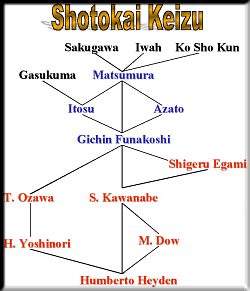
- Master Gichin Funakoshi (1868 - 1957), considered the father of modern Karate-do, studied in Okinawa under Yasutsune Azato - one of the greatest masters of the era - and Yasutsune Itosu, as well as Sokon Matsumura.
- 1922: Due to his extensive knowledge, culture, and high technical level, Funakoshi is invited to Tokyo to give a demonstration at the Ministry of Education's First Physical Education Exhibition. Important dignitaries persuade him to stay on the Japanese mainland, where he establishes himself permanently.
- Early Expansion: In Tokyo, after an arduous beginning, Funakoshi expands the art primarily through the university karate clubs (Keio, Waseda, Takushoku, Hitotsubashi, and others) - a cornerstone that defines traditional Shotokai practice to this day.
- 1930 - 1936: Funakoshi founds the Dai Nihon Karate-do Kenkyukai in 1930. In 1936, the organization formally adopts the name Dai Nihon Karate-do Shotokai (referencing the official Nihon Shotokai History).
- 1936: Funakoshi formally introduces the name "Karate-do" ("empty-hand way", replacing the older Chinese-hand ideogram). Later that same year, the prominent Okinawan masters convene in Naha and officially ratify this historic designation.
Continue to Part 2 (1936 - 1981) →