Tsutomu Ohshima: Kata, Tournaments and Personal Honesty
Archival Document • The Shotokai Encyclopedia Archive
Kata, Tournaments and Personal Honesty: An Interview with Tsutomu Ohshima
Tsutomu Ohshima studied directly under Master Gichin Funakoshi from 1948 to 1953 at Waseda University before arriving in the United States in 1955. He translated Funakoshi's master text, Karate-do Kyohan, into English (undertaken at the request of Master Shigeru Egami and the Shotokai elders). Throughout his life, Ohshima refused any rank higher than Godan (5th Dan), adhering strictly to the highest grade ever bestowed by O-Sensei.
The Interview
Although many claim to have created tournament competition, were you not the first to implement tournament rules? What was the original purpose?
Yes. The tournament system I devised used two referees and four corner judges. But what is truly most important to understand is why we introduced competition-style sparring at that time.
In post-war Japan around 1951–1952, the general public was crazy about baseball and other Western sports. You couldn't even buy tickets to baseball games, and crowds of young people flocked to watch them. I thought to myself: "Nobody comes to watch our karate practices." At the same time, when university students wanted to join, harsh seniors would kick them out simply because there was no floor space. I hated that dismissive atmosphere.
I told my peers that if we wanted traditional martial arts to survive for the next generation, we had to appeal to the public. We could formalize rules like other sports solely for public demonstration. But back then, I did not create competition for beginners, brown belts, or even first-degree black belts (Shodans). I did not trust their technical control or mental maturity. We only allowed Sandans (third-degree black belts), the absolute top tier in Japan, to demonstrate. The year I became Sandan, only eight people attained that rank in all of eastern Japan.
The university captains never fought; they stood by to ensure the atmosphere remained clean and courteous. Before that, university bouts were brutally physical with blood all over the floor. We wanted the public to see dignified, controlled martial arts. But every single one of us knew that the object of martial arts was not competition. Competition was solely an exhibition window to attract the next generation into authentic traditional practice.
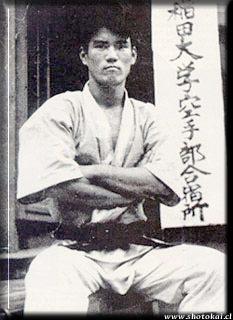
Master Tsutomu Ohshima • Direct disciple of Master Gichin Funakoshi.
When you arrived in the United States in 1955, how did Americans react, and why did you refuse to turn Karate into a sport?
When I arrived in America, the country already had hundreds of sports: football, baseball, basketball. People already knew how to play and enjoy games. Why would they come to learn another sport from me?
Some friends suggested adapting martial arts into a westernized sport, but I flatly refused. Why dilute an ancient art and destroy the traditional mentality and deep technical comprehension just to create another game? That would be ridiculous.
I felt our duty was to demonstrate through martial arts that our heritage was profound, serious, and intellectual: that we are serious human beings seeking self-mastery.
What is the true measure of martial practice compared to the values of modern society?
Modern society judges success almost purely by material wealth: money, luxury, possessions. But there is absolutely no correlation between possessing material things and genuine mental maturity.
What are heaven and hell on earth? Heaven on earth is when mature, compassionate individuals hold leadership and look after the lonely, the sick, and the immature. Hell on earth is when greedy, immature people seize power and force everyone else to suffer.
In martial arts, through grueling special trainings (thousands of continuous strikes and hours of continuous kata), students are stripped of vanity. They discover: "I believed I was strong, but inside I am weak, immature, and dishonest." Recognizing your own weakness and ugliness without excuses is the true awakening of the human spirit. To eliminate selfishness in the world, we must first cut out our own selfishness.
Master Tsutomu Ohshima • Deep immersion in the classical forms of Karate-do Kyohan.
You translated Master Funakoshi's Karate-do Kyohan and teach only the 19 classical kata. What is your view on people creating new kata?
One teacher invents a kata. His ten students each invent ten more. Within a few generations, there are ten thousand forms, and nobody knows which one is authentic. That is the worst degeneration imaginable.
The mentality of the public is variety and numbers: "How many kata do you know? I know thirty!" But for the genuine martial artist, the discipline must be completely the opposite: simplify, simplify, simplify.
If you know twenty kata, narrow them down to ten that are truly strong. If you know ten, cut them to five. In truth, even five are too many: cut it down to two kata. Perform each of those two 50,000 times. When you have done them 100,000 times, you will discover that one resonates even more deeply. Perform that one 50,000 more times. Only when you have reached 150,000 or 200,000 repetitions does that kata truly belong to you.
Kata is not memorizing external choreography to perform on a stage for applause. That is being an entertainer. True kata connects the subconscious and conscious mind directly to the physical movement until you and the form become one.
You stated previously that "the person with higher rank and authority should sacrifice himself for others." How does that apply to the dojo?
A leader is a first-class human being: someone who stands by himself, works hardest, and does so not for personal ego, but to nurture others. In martial arts, we are racing toward who can be strictest with himself.
In the 1950s, when our practice ended, I personally got down on my hands and knees and cleaned the dojo floor. The American students watched me and asked: "Hey Mr. Ohshima, you like cleaning?" I answered: "Yes." I never ordered them to do it. Cleaning the floor is showing reverence to the place that allows us to practice; polishing the floor is polishing my own mind.
After a few months, the senior black belts began grabbing rags to follow me. Soon, as soon as practice finished, the black belts rushed to clean, and the white belts followed naturally. We do not bark orders or treat juniors like servants. The highest person must work the hardest. That is how genuine respect is born.
"For the martial artist, the path is completely opposite to variety: we must simplify, simplify, simplify. If you know ten kata, cut it to five that are really good. Even five are too many: cut it to two. Perform each one 50,000 times... When you reach 100,000 or 200,000 repetitions, only then is that kata truly yours."