Interview with Master Atsuo Hiruma: Deai, Omoi, and the Flow of Budo
Historical Document • Shotokai Encyclopedia Archive
Deai and Omoi: Genuine Encounter, Benevolent Care, and the Search for the Living Body
Following the historic 1978 European journey of Master Shigeru Egami and subsequent meetings with Master Motonobu Hironishi, Master Atsuo Hiruma built an enduring pedagogical foundation across the Iberian Peninsula. In this dialogue recorded at the conclusion of the emblematic Tarifa summer camp, Hiruma Sensei outlines the ethical and biomechanical principles sustaining traditional Shotokai practice.
The Historic Dialogue
What are your primary objectives in the dissemination and evolution of Karate-do Shotokai?
My objective is to forge a deep, strong, and dynamic organization for the continuous development of the Karate-do taught by Master Gichin Funakoshi and researched and refined by Master Shigeru Egami.
What constitutes the essential spirit of this summer seminar in Tarifa?
For us, two concepts possess supreme significance: "DEAI" (true encounter) and "OMOI" (sincere, benevolent care and selflessness).
In intensive seminars of this kind, we place undeniable priority upon spiritual development and fraternity, far beyond external mechanics alone. Because practitioners arrive from many disparate regions, reciprocal knowledge emerges through collective exertion.
For example, when an entire kilometer is traveled advancing in low squat jumps across the sand, an authentic sense of mutual assistance and empathy arises, where practitioners urge one another onward to surpass their perceived physical boundaries together.
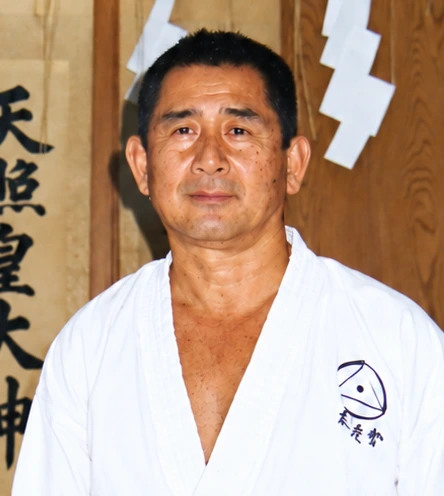
Master Atsuo Hiruma • Pioneer and technical director of Karate-do Shotokai in Spain and Portugal.
How do you evaluate the technical progression and maturity achieved by the participants?
All students make an honest effort to express the authentic Shotokai spirit. Our school does not participate in sports competitions; therefore, we do not chase superficial prizes or immediate trophies.
Instead, we accord immense value to the natural process of maturation, without rushing results, pursuing an increasingly profound and sincere understanding of Karate-do as a lifelong path of human development.
We have observed that alongside Karate techniques, you teach Bo staff and Tai Chi Chuan. What is the pedagogical purpose behind this integration?
The Bo is essential for coordinating the movement of the arms with the hips, for the exacting study of Hikite and Nigiri, and for experiencing true body heaviness in technique, because a long wooden staff cannot be manipulated by isolated muscular arm strength alone.
Tai Chi Chuan is indispensable for researching breath control, fluidity of motion, and balanced mastery of the bodily center of gravity.
The historical roots of Karate-do trace back to ancient China, where two broad traditions maintained opposing perspectives on the human body:
- The Southern Tradition: Regarded the body as a rigid, fortress-like structure, hardening the knuckles and limbs to withstand and inflict blunt impact.
- The Northern Tradition: Conceived the human body as a vessel filled with water: inherently flexible, vibrant, and alive with fluid wave energy.
Master Egami, through decades of relentless empirical research, arrived at the lucid realization: "The human body is not a rigid stone statue; it is naturally supple and alive." Consequently, a truly effective technique must penetrate the organism in its natural state of fluidity.
This insight of Egami directly aligns with the core principles of Northern internal arts:
- Impact energy must penetrate deeply into the internal organs rather than dispersing across the superficial surface.
- Total relaxation of shoulders and elbows, allowing the body's natural gravitational weight to drop.
- Complete synchrony of all bodily segments without localized muscular clenching.
- Frequent use of ippon-ken (single-knuckle fist) to reduce surface area and maximize penetrative resonance.
While classical Okinawan Karate-jutsu absorbed heavy Southern influences, delving deeper into its roots connects directly with the soft, expansive dynamic of the North. This is why Shotokai seamlessly integrates the Bo staff and Tai Chi Chuan into comprehensive practice.