MONDO: Zen Master Taisen Deshimaru on Competition, Mushotoku & Origins of Budo
From 'The Zen Way to the Martial Arts'
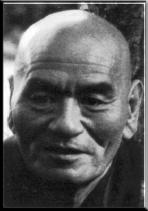
Zen Master Taisen Deshimaru (1914 - 1982) • Historical Archive
MONDO: Competition, Mushotoku & The Origins of Budo
In this second dialogue from The Zen Way to the Martial Arts, Master Taisen Deshimaru addresses the difference between sport competition and genuine Budo, the spiritual sickness of "championitis," the principle of mushotoku (action without desire for gain), and how unarmed martial techniques arose from wandering monks in ancient China and Okinawa.
The Mondo
Many people practice the martial arts in Europe, the United States, and Japan without really practicing the way of Budo or Zen. The general feeling is that the principles of Zen have nothing to do with martial arts as sports. What is your view?
People who do not want to follow the teaching of Zen, the true foundation of Bushido, do not have to do so. They are simply using the martial arts as playthings; to them they are sports like any others. But people who want to live their lives on a higher dimension do have to understand. Nobody can be compelled and nobody can be criticized. The first lot are like children playing with toy cars, while the second drive real automobiles.
I have nothing against sports; they train the body and develop stamina and endurance. But the spirit of competition and power that presides over them is not good, it reflects a distorted vision of life. The root of the martial arts is not there.
The teachers are partly responsible for this state of affairs: they train the body and teach technique, but do nothing for consciousness. As a result their pupils fight to win, like children playing war games. There is no wisdom in this approach and it is no use at all in the business of managing one's life. What good to them is their technique in everyday life?
Sports are only amusement and in the end, because of the spirit of competition, they wear out the body. That is why the martial arts should strive to recapture their original dimension. In the spirit of Zen and Budo everyday life becomes the contest. There must be awareness at every moment - getting up in the morning, working, eating, going to bed. That is the place for mastery of the self.
Is "championitis" a mental illness?
Of course. What a narrow vision of life! I do not mean that one ought never to become a champion; why not? It is an experience like any other. But one must not make an obsession of it.
In the martial arts, too, one must be mushotoku: without any goal or desire for profit.
Where do the martial arts come from?
The art of the sword, lance, bow, or simple fistfighting - they are almost as old as man himself, because he has always needed to defend himself from attack and to hunt in order to feed himself and his tribe. First, the weapon was discovered - spear, stone hatchet, slingshot, bow - then, gradually, by trial and error, the best possible technique was evolved for each arm. Fighting with their enemies, people learned which blows killed, which wounded, how to parry them, how to counterparry, and so forth.
The weapons themselves were perfected, techniques were systematized, and the whole became a part of the art of warfare and the hunt, both of which include other essential elements: knowledge of climate and weather, ability to interpret signs in nature (sounds, tracks, and prints, smells, etc.), understanding of the environment and of the psychology of the adversary (or game, in hunting), intuition of the right movement. A good warrior-hunter must be able to melt into the landscape, become part of it, know it intimately, and respect it.
But to return to the Eastern martial arts, the technique of fighting without weapons first became important in the days when itinerant monks were often attacked and robbed, if not killed, by soldiers and brigands - because the monks' vows forbade the use of weapons. A form of weaponless fighting was initially developed in China, in Bodhidharma's time, and later split into karate, judo, tai-chi, etc., and by means of these the monks could defend themselves on any occasion.
This was the source of the precise and efficient gestures of karate; the subtle judo-holds that utilize the adversary's own strength; the slow, supple, feline parries of tai-chi: they enabled the monks to take advantage of natural means of defense, adapted in every case to the energy of the individual.
In those days the "soft" martial arts were not divided into categories as now, but probably consisted of a collection of movements, blows, feints, and tricks, passed on from one man to the next in the course of their wanderings, just as they also exchanged their potions and recipes - plants, special massages, etc. - or their techniques of meditation (remember that before the Buddha began to practice zazen under his bodhi tree he received instruction from many yogis met on his travels). They also shared the experiences that had taught them something, moral and practical at once, relevant to their lives.
The itinerant monks carried all this knowledge from China to Japan, where, spreading out from the region of Okinawa, it met with spectacular success. Karate and judo became more popular there, while tai-chi remained specifically Chinese.
Tai-chi is still practiced today in China, every day on the streets and in factories in a sort of slow-motion ballet. What is your perspective on it?
Tai-chi used to be only for women and children, old people and the weak. It is a very interesting practice because it teaches the right kind of breathing (as in zazen), together with suppleness of the body and concentration of the mind.
It has been called "standing Zen"; but when all is said and done, it is just a dance, a sort of gymnastic without the true spirit of Zen.
"In the spirit of Zen and Budo everyday life becomes the contest. There must be awareness at every moment - getting up in the morning, working, eating, going to bed. That is the place for mastery of the self."