Takeshi Shimoda: Central Pillar of Early Shotokan
Archival Document • The Shotokai Encyclopedia Archive
Master Takeshi Shimoda (1901 - 1934)
Chief Assistant to Gichin Funakoshi • Master of Maniwa Nen-ryū Swordsmanship
Primary Source & Archival Corroboration:
• Documented in the official publication "There Is No First Strike in Karate-do: English Translation of the Nihon Karate-do Shotokai Booklet" (Pages 8, 13, published May 16, 2023 by Nihon Karate-do Shotokai Central Headquarters Dojo Shotokan, 2-1-7 Kikukawa, Sumida-ku, Tokyo, Japan).
• The historical photograph below of Master Gichin Funakoshi with Takeshi Shimoda was preserved and published by Master Shigeru Egami in his seminal work "The Way of Karate: Beyond Technique" (Kodansha International, 1976).
• Download Official English PDF Document
• View Official Announcement on Shotokai.jp (News #5329)
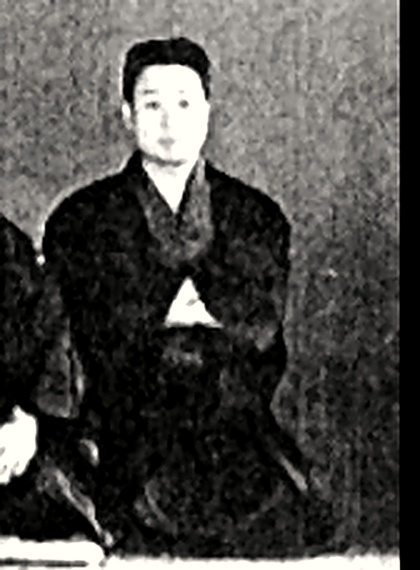
Master Takeshi Shimoda (1901-1934) - Restored Solo Portrait
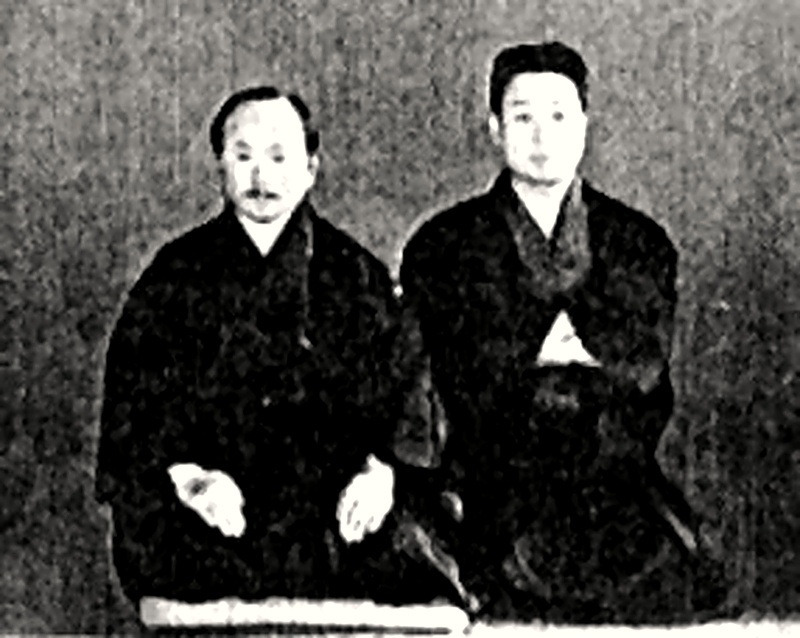 Historic photo: Master Gichin Funakoshi (left) with assistant Takeshi Shimoda (right), Tokyo c. 1930-1933 (from *Beyond Technique*)
Funakoshi’s Most Brilliant Early Mainland Disciple
In the pioneering decade of the 1920s and early 1930s, when Ōsensei Gichin Funakoshi was establishing karate clubs across Tokyo's premier universities (Keio, Waseda, Takushoku, Chuo), his principal teaching assistant and demonstrator was Takeshi Shimoda (下田 武, 1901 - 1934).
Shimoda was an extraordinary budoka. Prior to dedicating his life to karate under Funakoshi, he had attained deep mastery in classical Japanese swordsmanship as an expert practitioner of Maniwa Nen-ryū (馬庭念流), one of Japan's oldest schools of kenjutsu founded in the 14th century, and had also studied classical ninjutsu.
Integrating Sword Dynamics with Karate
Shimoda brought the acute spatial awareness (ma-ai), footwork (tai-sabaki), and decisive focus of classical swordsmanship into his karate practice. Funakoshi recognized in Shimoda a rare martial talent, a mainland practitioner who embodied the traditional principle:
"Treat your arms and legs as if they were drawn swords."
- Ankoh Azato & Gichin Funakoshi
As Funakoshi's assistant instructor, Shimoda taught alongside the master and took over instructional duties whenever Funakoshi was away. In The Way of Karate: Beyond Technique, Master Shigeru Egami remembered Shimoda with immense respect:
"He wasn't a big man, and he kept a low posture; he didn't seem to hit the striking-post very powerfully. I was amazed to find out that he practiced a thousand punches with one fist everyday, and when it rained, he would practice anyway with an umbrella over his head. I was even more amazed when I was made to stand before him and receive his punch. Although his blows were light, I simply could not ward him off, no matter how hard I tried."
Shimoda's ability to generate undeflectable penetrative force without relying on rigid tension left a lasting impression on Egami, later inspiring Egami's postwar quest for natural, relaxed execution.
The Demonstration Tours and Untimely Passing (c. 1934)
Around 1934, roughly twelve years after Funakoshi's first public demonstration in Tokyo, Master Funakoshi organized demonstrations across the Kyoto, Osaka, and Kyushu regions to introduce Okinawan karate to new audiences. Takeshi Shimoda led these trips, accompanied by a group of Funakoshi's university disciples that included young Shigeru Egami (as recorded in Marco Forti's historical study Shōtōkai No Rekishi, FIKTA, 2003, pp. 8-9, citing Egami's writings).
Karate was still largely viewed with curiosity and mystery, and the touring students conducted intense demonstrations across the region. Tragically, Shimoda fell seriously ill following one of the demonstrations and passed away shortly afterward in 1934, at only 33 years of age.
The Succession of Yoshitaka Funakoshi
Shimoda's sudden death dealt a heavy blow to Master Gichin Funakoshi and presented a serious challenge for the early Shotokan movement: who could step into the shoes of Funakoshi's most skilled instructor?
Master Funakoshi turned to his third son, Yoshitaka (Gigō) Funakoshi, who was working as a radiographer at Tokyo Imperial University Hospital and the Ministry of Education. Although initially hesitant to take on the responsibility, Yoshitaka yielded to the earnest requests of his father and senior students.
Yoshitaka took over Shimoda's duties and went on to lead a dynamic technical evolution, lowering stances, developing dynamic kicks, and formalizing modern kumite. Thus, Shimoda's tragic loss marked the historic turning point that brought Yoshitaka Funakoshi into full-time technical leadership of early Shotokan.
Key Historical Data & Archival Citations
- Born: 1901, Japan
- Died: 1934 (aged 33)
- Kanji: 下田 武
- Martial Background: Expert in Maniwa Nen-ryū Kenjutsu; studied classical ninjutsu
- Role: Chief Assistant Instructor to Gichin Funakoshi
- Historical Significance: Regarded by Shigeru Egami as the most talented of Funakoshi's early disciples; his untimely death in 1934 led to Yoshitaka Funakoshi assuming teaching responsibilities.
- Archival References & Bibliography:
- Marco Forti, Shōtōkai No Rekishi: Excursus sulla storia del Karate-dō del M° Shigeru Egami, FIKTA Corso Maestri, 2003, pp. 8-9, 14.
- Shigeru Egami, The Way of Karate: Beyond Technique, Kodansha International, Tokyo, 1976 (revised as The Heart of Karate-Do, 2000, pp. 11-12).
- Nihon Karate-do Shotokai Hombu, There Is No First Strike in Karate-do, Tokyo, 2023, pp. 8, 13.
- Gichin Funakoshi, Karate-dō: My Way of Life, Kodansha International, Tokyo, 1975.