Shigeru Egami's Technical Revolution: Soft Karate, the Penetrating Strike, and Budo Sparring
The Pursuit of True Combat Efficacy, the Influence of Hoken Inoue, and Why Shotokai Rejected Tournament Sparring
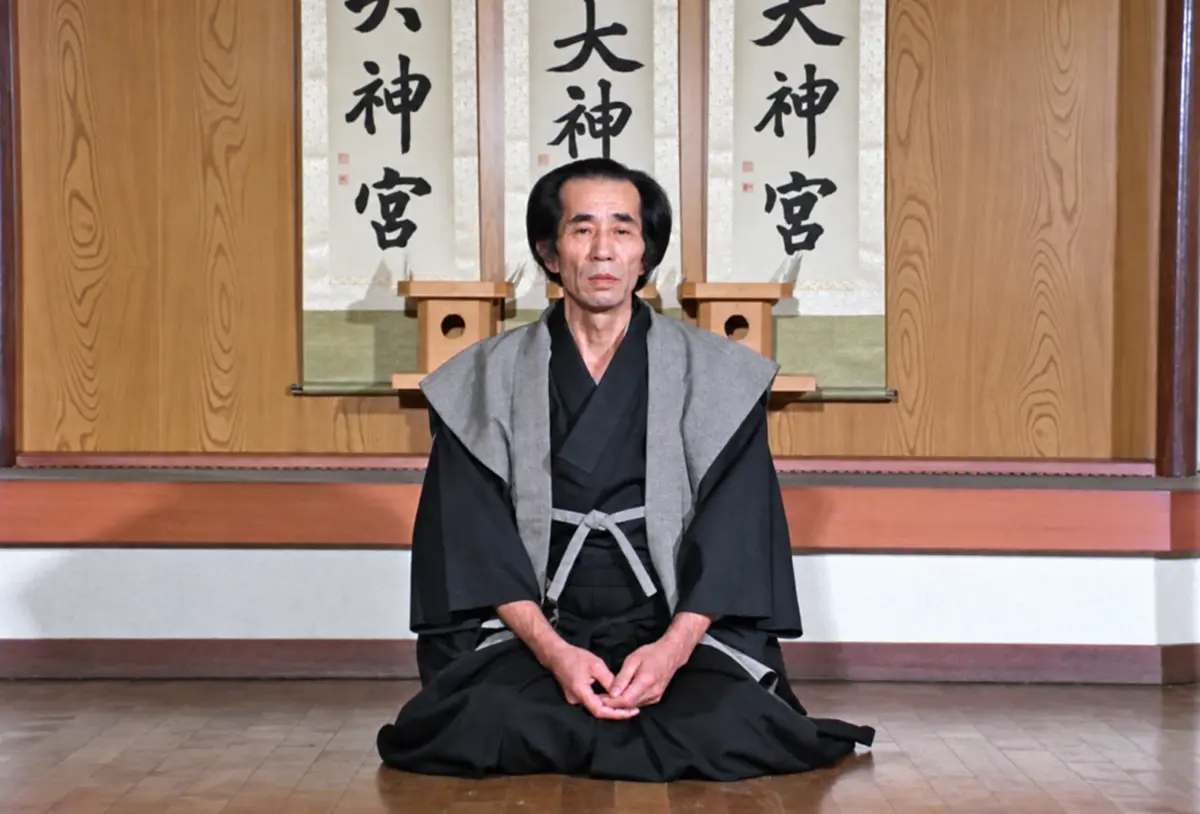
Master Shigeru Egami, Supreme Instructor of the Shotokan and pioneer of soft karate.
Throughout the twentieth century, Karate-do underwent a worldwide explosion in popularity. Yet as the art expanded, a profound divide emerged between modern athletic sports karate and classical martial budo. At the epicenter of this philosophical and technical crossroads stood Master Shigeru Egami (1912 - 1981), Ōsensei (大先生) Gichin Funakoshi's most revolutionary yet orthodox disciple.
To the outside observer, the "soft karate" (yawarakai karate) developed by Master Egami during the 1950s and 1960s often appeared enigmatic. How could an art renowned for breaking wooden boards and smashing roof tiles abandon muscular tension, embrace flowing relaxation, and reject free tournament sparring?
Through the historical recollections of his closest disciple, Master Tomotsugu (Tomoji) Miyamoto, the true impetus behind Master Egami's technical revolution comes into sharp, uncompromising focus: it was not born from romantic pacifism, but from an obsessive, relentless pursuit of authentic combat efficacy.
The Crisis of the Rigid Punch: Confronting the Illusion
In his youth as a star practitioner at Waseda University, Shigeru Egami was a fanatic of physical conditioning. He pounded the makiwara (striking post) thousands of times daily, calcified his knuckles, practiced tameshiwari (breaking boards and tiles), and developed a muscular, ironclad physique. He believed implicitly in the pre-war legend of ikken hissatsu (killing with a single blow).
Yet as he tested his punches against actual human bodies, Egami encountered a shocking truth that shattered his confidence:
"When you look for techniques that are genuinely effective, you end up having to make them soft," Master Miyamoto explained, recounting Egami's personal confessions. "Watching karate, it seems as though striking with a hardened, tense fist would be the most devastating method. But Professor Egami had the captain of the Waseda University karate club punch him directly in the stomach with full force. He was astonished at how ineffective a conventional karate punch actually was. He realized that the hardened fist collided with surface abdominal muscle and bounced off. The only punches that shook the internal organs were those delivered by western boxers."
This devastating experiment triggered a profound existential crisis for Egami. If the rigid, clenched fist could not penetrate the muscular armor of a conditioned human being, the entire foundational premise of modern karate practice was flawed.
The Catalyst: Tadao Okuyama and the Influence of Hoken Inoue
The turning point occurred through a fellow Waseda karateka, Tadao Okuyama. Okuyama, a younger peer of Egami known for his extraordinary natural fighting ability, demonstrated a completely different method of striking:
"While researching why the conventional karate punch was not working," Miyamoto related, "a junior member of the Waseda karate club named Tadao Okuyama showed Professor Egami a relaxed, fluid single-fist thrust. Okuyama said: 'This is what the punch of my teacher, Hoken Inoue, looks like.'
Professor Egami received that punch, and he told me that he immediately realized: 'This is completely, fundamentally different from a normal punch.' That single experience led him to attend Master Inoue's dojo, and from that encounter his entire modern punching technique was born."
As documented in Marco Forti's historical analysis Shōtōkai No Rekishi (FIKTA, 2003, pp. 14, 19, 31, 43), Okuyama's role was pivotal. Around 1953, Okuyama demonstrated to Egami that rigid muscular tension obstructed genuine martial penetration. Seeking to test Master Hoken Inoue directly, Okuyama had traveled to Kyoto to challenge Inoue at his dojo; Okuyama attacked Inoue with extreme violence, but Inoue naturally evaded and threw Okuyama to the ground without effort. Convinced by Inoue's mastery, Okuyama became his disciple and then introduced Egami to Inoue's teachings. Okuyama himself later withdrew from competitive karate politics, dedicating himself to classical Budo in Kameyama (Kyoto).
(Note: While Marco Forti and Clive Layton cite Inoue's dojo location as Kameyama in Kyoto, martial arts historians observe that Kameoka in Kyoto was the historic spiritual center of the Omoto community closely tied to Inoue and Morihei Ueshiba).
Okuyama subsequently introduced Egami to Master Hoken Inoue (founder of Shinwa Taido and nephew of Aikido founder Morihei Ueshiba).
From Master Hoken Inoue, Egami assimilated the philosophical and biomechanical concept of Heihō (兵法 - Method of Peace / Art of Peace). Inoue taught movement rooted in spherical non-resistance, relaxed alignment, and cosmic harmony. Under this influence, Egami realized that true Karate-do must transcend crude combat violence (Bujutsu) to become Heihō, a sacred vehicle of peace, harmony, and mutual empathy. This philosophy became the foundational pillar of his landmark 1970 treatise, Karate-do Senmon-ka ni okuru (Karate-do: For the Specialist).
Ōsensei (大先生) Gichin Funakoshi's parting mandate to his senior disciples now had its clearest path forward:
"From now on, I want you young people to research and develop this art further."
Master Egami accepted this charge with sacred devotion. His duty was to elevate the ancient art once known as the "secret art of the Southern Seas" (nanto no hijutsu) beyond crude physical clashes into a perfected spiritual and physiological science.
The Mechanics of Penetration: Conventional Karate vs. Western Boxing vs. Egami's Tsuki
To understand why Master Egami's soft thrust (tsuki) was so devastating, one must examine his own empirical findings recorded in The Way of Karate: Beyond Technique (Kodansha, 1976, pp. 24-28; also cited by Marco Forti, Shōtōkai No Rekishi, pp. 22-24):
- The Conventional Karate Strike: Relies on surface kime (abrupt muscular contraction at the instant of contact coupled with the sharp retraction of the opposite fist, hiki-te). In Egami's experimental tests, when veteran karateka struck his tensed abdomen, their punches produced surface pain but failed to penetrate deeply because the sudden contraction halted the transmission of mass.
- The Western Boxing Punch: When Egami invited boxers to punch his abdomen, he discovered their blows were far more devastating. The boxer threw weight straight through the target without braking upon contact, shaking the body's internal equilibrium.
- Egami's Soft Penetrating Strike: Inspired by Inoue's teachings, Egami eliminated muscular contraction and abrupt braking. Driven directly by the forward commitment of the body's center of gravity (hara / seika tanden and Iri-mi), the relaxed arm acts as an uninhibited conduit. Because the fist and body remain supple without rigid rebound, the power travels straight into the receiver's core rather than bouncing off surface muscle tension.
As Master Tomoji Miyamoto testified from personal experience:
"If you actually experiment in the dojo, you will see that hard, rigid thrusts are surprisingly easy to block or absorb. There are simple physical tricks to neutralizing them: if the defender shifts slightly forward or backward at the precise moment of impact, the colliding shockwave is drastically dispersed.
However, soft, gliding thrusts do not respond to that kind of shifting. Because they carry no rigid recoil, they bypass surface tension and travel straight through into your center."
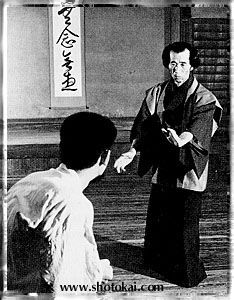 Master Shigeru Egami researching body connection and relaxed extension with Tomoji Miyamoto.
From the outside, a soft Shotokai thrust can appear light or floating. But when standing in front of it, the defender feels a deep, terrifying penetration that cannot be dispersed by tensing the body.
Furthermore, defensive parrying against such strikes requires an entirely different plane of sensitivity:
"You cannot deflect that kind of thrust by simply swatting it to the side," Miyamoto observed. "If you try to slap it away, your hand simply slides off the relaxed limb. To parry an authentic soft thrust, you must accurately read the incoming trajectory and redirect the force precisely into the opponent's waist and center of gravity. Through that practice, one begins to understand which techniques are genuine and which are superficial."
The Ghostly Parry: Disrupting the Center of Gravity
One of the most revealing episodes in Master Miyamoto's testimony describes his personal attempts to test Master Egami in practical exchange.
As a young man in his twenties, Miyamoto was physically imposing, athletic, and possessed exceptional leg and hip drive. He was accustomed to bowling over senior students, even when they attempted to parry his attacks.
Yet when he faced Master Egami, who was then elderly, frail, and plagued by illness, Miyamoto found himself completely helpless:
"I was a troublesome junior back then, because my lower body was solid and I would just keep thrusting right through my seniors' blocks," Miyamoto confessed. "But I was utterly no match for Professor Egami's parries. The quality was completely different; he parried with unimaginable softness.
It did not hurt where his hand touched you; you felt no pressure on your skin. Yet the moment he made contact, he sensed the exact angle, depth, and intention of your thrust. Without exerting any opposing force, he simply guided your vector off balance, and you were flipped over with a resounding crash."
Decades later, after mastering traditional Wu-style Tai Chi Chuan under Master Ma Changxun, Miyamoto recognized that Master Egami had spontaneously uncovered the pinnacle of internal martial arts (neijia): the ability to listen to the opponent's energy (ting jin), dissolve incoming force (hua jin), and disrupt their equilibrium at the root (fa jin).
Master Taiji Kase on Toate and Masaru Mizushima's Eyewitness Testimony
One of the most debated and extraordinary phenomena associated with Master Shigeru Egami's late technical evolution is Toate (当身 / 遠当て - the distant strike without physical impact).
In his historical treatise Shōtōkai No Rekishi (FIKTA, 2003, p. 32), Marco Forti documents the authoritative testimony of Master Taiji Kase (9th Dan, one of the foremost pioneers of Shotokan Karate in Europe, interviewed by Martin Fernandez Rincon):
When asked whether Toate existed in Karate, Master Taiji Kase affirmed:
"Yes, Toate truly exists, and I had the opportunity to see it performed. I believe that only very few masters, such as Sensei Egami or Yoshitaka (Funakoshi), managed to deepen and apply this aspect."
This remarkable confirmation from Master Kase - a master of legendary fighting prowess outside Shotokai - is corroborated by the firsthand account of Masaru Mizushima (founder of Yutenkai). As recorded by Forti (pp. 23, 32-33), during an intense training exchange with Master Egami, Mizushima launched a committed attack:
"Without him touching me, I was projected and lost consciousness. This happened several times. I cannot explain it."
Far from theatrical mysticism, Master Egami understood this phenomenon as the ultimate refinement of unified intent (kiai), supreme spatial control (ma-ai), and reading the opponent's neural intent (sen no sen) at the precise fraction of a second before kinetic release.
Why Shotokai Discarded Free Sparring and Point Tournaments
In the 1960s, competitive sparring (jiyu kumite) and point-scoring tournaments were rapidly sweeping the karate world. Yet Master Egami and the Nihon Karate-do Shotokai adamantly refused to enter the sporting arena.
When Master Miyamoto asked Egami directly why Shotokai did not practice modern free sparring, Egami provided an uncompromising critique:
"When practitioners engage in tournament sparring, they naturally select only the techniques that are quickest and easiest to score points with. As an inevitable result, the vast diversity of martial technique atrophies, and the body's expressive capacity becomes impoverished.
Most critically, sporting competition (kyogi) is fundamentally different from a real battle to the death (shinken shobu). The physical habits, psychological reflexes, and spatial sensibilities become entirely tailored to the arbitrary rules of sport. In the process, the authentic sensibilities of life-and-death budo are completely extinguished."
Master Egami's perspective was not theoretical. Having served during World War II as an instructor of hand-to-hand combat at the elite Nakano Army School (Rikugun Nakano Gakko) - where operatives were trained for deep-reconnaissance, espionage, and unarmored survival - Egami understood lethality intimately.
He recognized that sport karate encourages superficial tapping, hasty retreats, and artificial distance (maai), creating a dangerous illusion of combat competence:
"No matter what method you choose," Miyamoto reflected on Egami's teachings, "if you do not have a leader with true spiritual insight by your side, tournament sparring ends up being nothing more than practicing swimming on a tatami mat."
While acknowledging that sports karate serves a useful modern role in introducing youth to physical fitness and international competition, Master Egami insisted that students must never confuse the sport with the sacred path of budo.
Limit-Pushing Practice: Awakening True Softness Beyond Exhaustion
A persistent misconception is that Master Egami's "soft karate" was an intellectual, gentle exercise resembling slow-motion gymnastics. Nothing could be further from historical reality.
True relaxation was discovered through harrowing, limit-pushing training sessions conceived by Master Egami and developed by Hiroyuki Aoki and the Rakutenkai group during the 1960s:
- Endless Chasing Punches (Oi-Zuki): University practitioners performed continuous forward-stepping punches across the floor for hours without pause, until their uniforms were drenched and their consciousness began to blur.
- Hopping and Leaping Drills: Students were made to hop in deep stances around the perimeter of the gymnasium dozens of times until their quadriceps failed completely.
- Practice in Total Darkness: Kata and partner drills were conducted in pitch-black dojos, forcing students to abandon visual reliance and develop intuitive spatial sensing (chokan) to avoid collisions.
Master Miyamoto explained the profound purpose behind this extreme exhaustion:
"Our training began from the point where we reached our absolute physical limits. The techniques that emerged were born from a state where you could no longer tense your muscles even if you wanted to. It was not about consciously trying to 'relax' or 'be flexible'; it was about striking from a genuinely drained, wobbly condition.
When every ounce of artificial ego and superficial muscular tension was burned away, the body had no choice but to rely on its natural skeletal structure, breath, and spirit. That is where authentic softness was discovered."
The Enduring Heritage of Egami Karate
Master Shigeru Egami's technical journey was a masterclass in relentless martial honesty. He dared to question the orthodoxy of his day, discarded ineffective dogma, and sought the ultimate harmony between devastating martial effectiveness and deep human compassion.
Through his soft, penetrating strike, his effortless deflections that gently disarmed aggression, and his refusal to degrade Karate-do into a game of points, Master Egami left behind an immortal blueprint.
As Master Tomoji Miyamoto testified half a century later, this heritage endures as a profound beacon for all true seekers:
"Karate is not an instrument of violence, nor a game of trophies. It is an experiential path of self-discovery, leading human beings toward the ideal of naturalness, truth, and mutual understanding."
Archival Citation & References
This technical analysis is synthesized from the official commemorative interview:
- Source: "My Teacher, Shigeru Egami" (Part 1: The Ideal Adult, July 17, 2018; Part 2: The Meaning of 'A Starting Point', August 1, 2018).
- Publication: Co2 / Kotsu Editorial Department (
ko2.tokyo), Tokyo, Japan. - Occasion: Commemorating the official publication of Master Shigeru Egami's Karate-do Kata Textbook with DVD (July 11, 2018).
- Narration: Master Tomotsugu (Tomoji) Miyamoto.
- Historical References & Archival Studies:
- Marco Forti, Shōtōkai No Rekishi: Excursus sulla storia del Karate-dō del M° Shigeru Egami, FIKTA Corso Maestri, 2003 (specifically pp. 14, 19, 23, 31-34, 37-40, 43 regarding Okuyama, Inoue, boxing biomechanics, Taiji Kase's testimony on Toate, and Masaru Mizushima's experience).
- Shigeru Egami, The Way of Karate: Beyond Technique, Kodansha International, Tokyo, 1976.
- Shigeru Egami, Karate-do Senmon-ka ni okuru (Karate-do: For the Specialist), Sports Life Sha, Tokyo, 1970.
- Chiyoko Egami, Kimikagesō (君影草), Tokyo, 1985.