The 1970s Egami Kata Film: Tomoji Miyamoto and the Concept of the 'Draft'
The Grueling One-Day 16mm Filming of the 16 Shotokan Kata and Master Shigeru Egami's Vision of a Universal Baseline
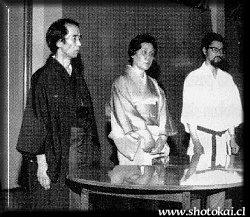
Master Shigeru Egami (left), his wife Chiyoko and Miyamoto Sensei
On July 11, 2018, four decades after its original conception, an extraordinary historical treasure of Japanese martial arts was finally released to the public: Master Shigeru Egami's Karate-do Kata Textbook with DVD (Karate-do Kata Kyohon). The 247-page hardcover volume presented Master Egami's previously unpublished technical manuscripts on the sixteen foundational kata of Shotokan and Shotokai, accompanied by a digitally restored full-color reproduction of 16mm motion picture footage filmed in the mid-1970s.
The film features an evocative spoken introduction by Master Egami himself - his hands moving characteristically in shorthand transcription - and complete demonstrations of all sixteen kata performed by a young Master Tomotsugu (Tomoji) Miyamoto.
Behind this historic footage lies an extraordinary human and philosophical story: an unexpected mandate, a punishing one-day filming marathon that pushed its demonstrator to absolute physical exhaustion, and Master Egami's revolutionary concept of the tatakidai (叩き台) - the pedagogical "draft" or anvil upon which future generations must forge their own understanding.
An Unexpected Mandate: "Do All Sixteen Forms by Yourself"
In the mid-1970s, Master Egami, who had served as Ōsensei (大先生) Gichin Funakoshi's chosen successor as Supreme Instructor of the Shotokan, recognized that Karate-do stood at a perilous historical crossroads. Across post-war Japan, university clubs and emerging sports federations were fragmenting the martial tradition, transforming ancient forms into theatrical gymnastics for point competition.
Determined to establish an enduring record of Funakoshi's orthodox heritage combined with his own decades of technical research, Master Egami began compiling a comprehensive kata manual. When the time arrived to record the accompanying visual archive on 16mm film, thirty-year-old Tomoji Miyamoto was summoned to the master's study.
"I assumed the master was going to ask me which single kata was my favorite," Master Miyamoto recalled. "In our school, there were many senior practitioners who were renowned as absolute specialists for particular forms - someone celebrated for Kanku Dai, someone else renowned for Hangetsu or Bassai. Instead, Master Egami handed me the entire stack of manuscript pages and said calmly: 'You do all of these forms by yourself.'"
Miyamoto was struck speechless. Performing all sixteen classical kata on camera was a monumental responsibility that would invite microscopic scrutiny from senior instructors across Japan.
"I stood there in shock," Miyamoto continued. "The only thing I managed to stammer was: 'Please wait a moment, Sensei. In that case, could you at least give me some time to practice?'
Master Egami looked at me and replied: 'Even if I gave you more time, you would say the exact same thing when the cameras began rolling. It is a never-ending cycle. Just perform with all the strength and honesty you possess right now.'"
The Grueling One-Day Shoot: Filming to the Point of Collapse
Because the scheduling window was extremely tight, the entire 16mm filming project had to be executed in a single, continuous day. As Miyamoto recounted: "We were in a hurry to film because we were short on time."
The shoot commenced methodically with the five Heian forms (Shodan through Godan), followed by Tekki Shodan. At first, Miyamoto was physically fresh, executing the movements with crisp precision. But as the day wore on, the demands of the camera crew escalated dramatically.
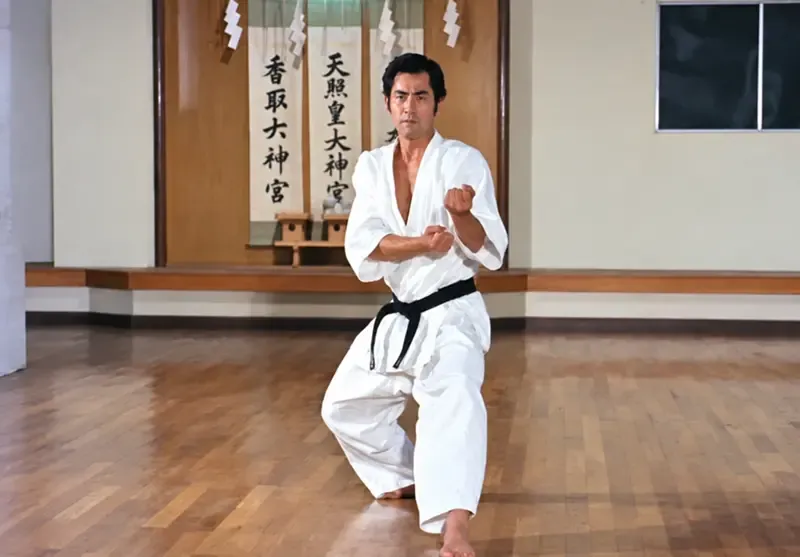 Master Tomoji Miyamoto at age 30 demonstrating kata at the historic Shotokan Hombu Dojo in Tokyo before the Shinto Kamidana and the hanging scrolls of Amaterasu Kotai Jingu and Katori Daijingu, captured on 16mm film for Master Shigeru Egami's archival textbook project.
As the filming progressed into the long, physically punishing advanced kata - Bassai Dai, Kanku Dai, Hangetsu, Jitte, Enpi, Gankaku, Jion, Chinte, and Meikyo - the directors required repeated takes:
- Complete forms were recorded from primary frontal angles.
- Crucial sequences were repeated from diagonal and lateral angles.
- Specialized high-speed cameras were deployed to capture intricate footwork and explosive transitions in slow motion.
For advanced forms such as Gankaku, which demands explosive jumping turns and one-legged balance (tsuru-ashi-dachi), performing multiple repetitions became a grueling test of endurance.
"When I watched the remastered film decades later, I could clearly see my legs beginning to wobble in the second half," Miyamoto reflected with a self-effacing laugh. "Filming started with the short, basic Heian kata, but by the time we reached the complex, spinning leaps of the advanced kata, the crew was constantly shouting: 'Once more from this angle!' and 'Once more for the high-speed camera!'
By the end of that day, my legs were shaking from absolute muscular exhaustion. For decades afterward, I hated watching that film because it brought back the sheer physical agony of that shoot."
Yet to viewers of the film, Miyamoto's execution reveals an authentic, natural gravity precisely because artificial muscular tension had been drained away by fatigue.
The Philosophy of the "Draft" (Tatakidai)
Why did Master Shigeru Egami insist that a thirty-year-old student demonstrate the entire repertoire alone, rather than assembling an all-star roster of veteran masters?
The answer reveals Master Egami's profound humility and pedagogical genius. In discussions with Miyamoto, Egami invoked the classical Japanese concept of a tatakidai (literally, an anvil or chopping block - colloquially used in Japanese to denote a springboard, rough draft, or working proposal presented openly to be tested and refined):
"Master Egami told me: 'No one can create something perfect. Perhaps everyone will criticize your performance. You may even be slandered by seniors and peers. But even so, five, ten, or fifty years from now, something genuine will evolve from that: a new standard baseline for those who follow in the footsteps of Gichin Funakoshi. That is why I want to appeal through this project: we first need a standard, a starting point to begin with.'"
Master Egami understood that if an established elder master presented a "flawless" performance, it would become an untouchable monument - dogmatic, frozen, and beyond debate. By selecting a sincere, dedicated thirty-year-old disciple to execute the entire syllabus as a unified whole, Egami deliberately created a living, accessible baseline.
He invited honest dialogue, allowing practitioners to examine the footage and ask: "How should this transition be executed? What is the functional connection between the hip and the arm here?" The film was designed not as an authoritarian museum artifact, but as a catalyst for active inquiry.
Standardization vs. Unconstrained Expression: Restoring the Grammar
To fully understand Master Egami's motivation for producing the kata textbook and film in the 1970s, one must view it against the radical experiments of the late 1960s.
During the mid-1960s, Master Egami, working alongside Hiroyuki Aoki and the experimental group Rakutenkai, pushed the physical limits of karate training. In summer camps at Iwai beach and mountain retreats, practitioners engaged in dynamic jumping exercises, leaping across entire dojos in single, explosive strides, and practicing in pitch darkness to awaken intuitive reflexes.
While these extreme methods shattered artificial mental boundaries and unlocked profound body relaxation, they produced an unintended consequence: the structural grammar of classical kata began to dissolve.
"In our training back then, our movements were so expansive that we would leap across the entire dojo in a single step, almost running through the kata," Miyamoto explained. "Sensei Egami recognized that while this was a magnificent training drill to transcend physical limits, it could not become the universal standard for kata itself."
Master Egami recognized the acute danger: without a clearly defined anchor, orthodox karate would dissolve into idiosyncratic personal habits.
"Master Egami decided that we needed a common standard form (hyojunteki na kata) to which every student could return," Miyamoto noted. "It was impossible to simply regress to the pre-war era, because our punches and stances had evolved into a more penetrating, relaxed art. But the fundamental architecture of the kata had to be clearly established from Hokkaido in the north to Okinawa in the south.
The goal was to establish a universal movement language, so that a student entering any Shotokai dojo across Japan would immediately recognize: 'Ah, this is the same kata my teacher taught me. We are walking the same path.'"
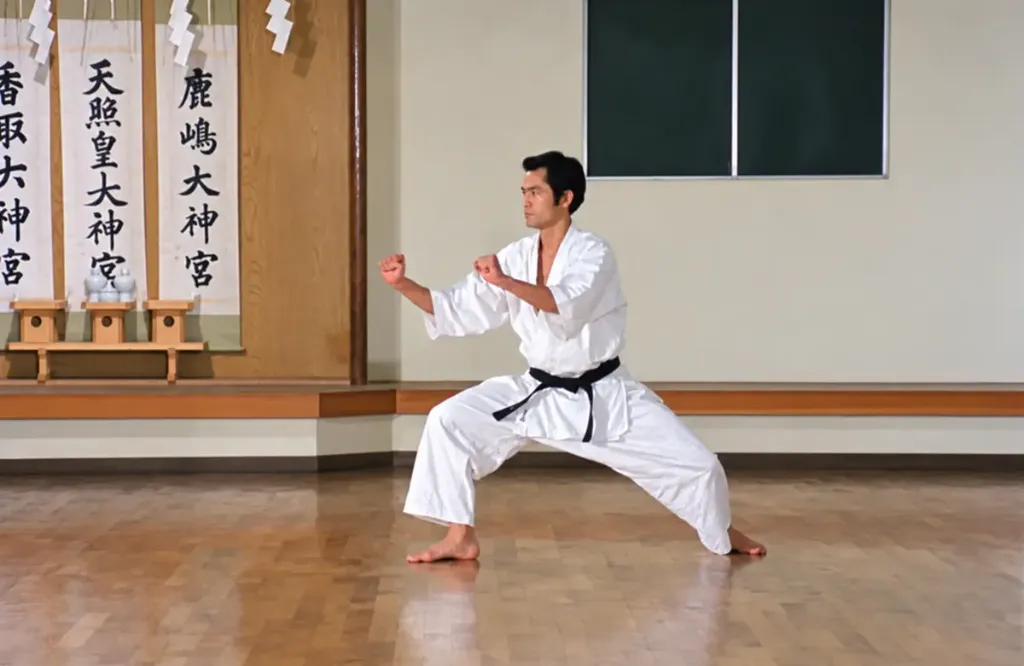 Master Tomoji Miyamoto demonstrating deep rootedness and relaxed extension during the historic 16mm film shoot.
Delineating Attack and Defense: The Pedagogy of Forms
A vital insight revealed in Master Miyamoto's commentary concerns the functional interpretation of classical techniques.
In authentic budo karate, an axiom holds that every defensive block (uke) is simultaneously an offensive strike (atemi). In the post-war Shotokai dojo, this awareness became so intense that senior practitioners often discarded defensive mechanics entirely - executing a downward sweep (gedan barai), for instance, as a direct strike into the opponent's groin or thigh.
Master Egami recognized that while such offensive transitions naturally emerge in advanced combative practice, teaching them prematurely to beginners destroyed their understanding of basic mechanics:
"In the initial stages of learning kata, it is essential to define the punch and the block clearly first," Miyamoto emphasized. "If you do not master the precise trajectory of the block and the counter first, the movement becomes indistinct. Once the foundation is securely established, functional variations will arise naturally."
The 1970s film and textbook were meticulously structured to preserve this pedagogical clarity: clean lines, grounded stances (fudo-dachi and zenkutsu-dachi), and distinct transitions that honor Ōsensei Funakoshi's forms while infusing them with Egami's relaxed, flowing power.
An Enduring Living Monument
When Master Shigeru Egami passed away in January 1981, his kata manuscript remained unpublished, carefully preserved by his family and senior disciples. Its eventual publication in 2018 - accompanied by the full 16mm digital restoration - was a landmark event for martial artists worldwide.
Looking back on that exhausting single day in front of the cameras four decades earlier, Master Tomoji Miyamoto recognized that his beloved teacher's vision had been fully realized. The film was never intended to display an unapproachable virtuoso; it was gifted to the martial arts world as an open door, a humble and noble invitation to research the eternal principles of Karate-do.
As Master Egami famously proclaimed in his opening address on the DVD:
"Kata is not merely a combination of forms. It is the crystallization of the heart, mind, and spirit of our predecessors. Through honest repetition, one discovers not combat, but the universal essence of life itself."
Archival Citation & References
This historical analysis is synthesized from the official commemorative interview and monograph:
- Monograph: Shigeru Egami, Karate-do Kata Kyohon with DVD (Karate-do Kata Textbook with DVD), 247 pp., published by Kotsu / Co2 Editorial Department, Tokyo, Japan (July 11, 2018). Hardcover edition featuring Master Egami's manuscript, spoken message, and Tomoji Miyamoto's kata demonstrations and technical commentary.
- Source Interview: "My Teacher, Shigeru Egami" - Part 2: "The Meaning of 'A Starting Point'" (Tatakidai no Imi), published August 1, 2018, by Co2 Editorial Department (
ko2.tokyo). - Narration: Master Tomotsugu (Tomoji) Miyamoto.
- Production Cooperation: Ken Egami.