Tomoji Miyamoto: The Ideal Adult and a Decade Dedicated to Master Egami
From an Unruly University Freshman to Master Shigeru Egami's Closest Disciple and Preserver of Orthodox Shotokai
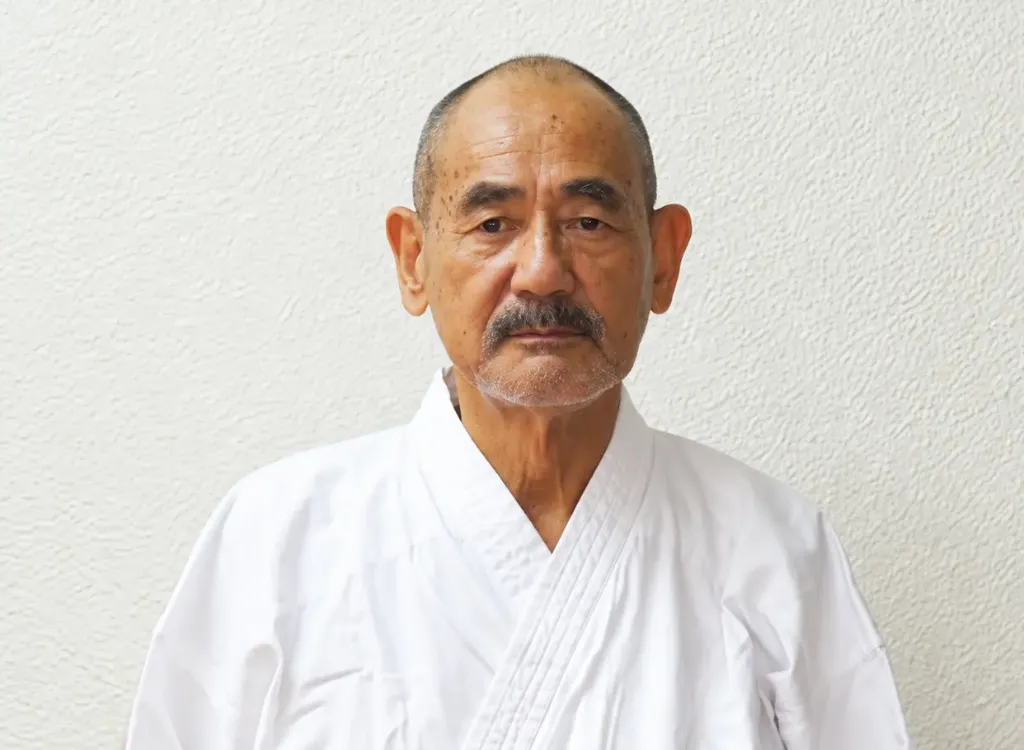
Master Tomoji (Tomotsugu) Miyamoto, lifelong disciple of Shigeru Egami and master of Yuten Karate Miyamoto Dojo.
In the history of post-war Karate-do Shotokai, few figures embody the bridge between Master Gichin Funakoshi's classical heritage and Master Shigeru Egami's revolutionary technical evolution as faithfully as Master Tomotsugu (Tomoji) Miyamoto. Revered across Japan as a senior instructor of the Shotokan Hombu Dojo, Professor at Chuo University (Director of the Institute of Health and Physical Education), and the technical model for Master Egami's landmark 1976 work The Way of Karate: Beyond Technique, Miyamoto's path into martial arts was neither conventional nor serene.
Rather, it was forged through an extraordinary meeting of destinies: a rebellious freshman surviving brutal university hazing, an unforgettable encounter in a secluded mountain hot spring, catastrophic family tragedies that revealed the fragility of human existence, and a solemn vow to surrender his entire youth to the care and vision of Master Shigeru Egami.
The 1965 Chuo University Crucible: Surviving Through Defiance
Born in Tokushima Prefecture in 1946, Tomoji Miyamoto possessed a naturally robust physique and an independent spirit. During high school, he briefly explored Goju-ryu karate and even traveled to Ikebukuro in Tokyo to inspect the burgeoning full-contact dojo of Masutatsu Oyama (Kyokushin). Yet the rigid competitive atmosphere did not resonate with his inner sensibilities.
In the spring of 1965, Miyamoto entered Chuo University to study law and promptly joined the Chuo University Karate Club. At that time, university martial arts clubs operated under an unforgiving regime of attrition. Approximately one hundred freshmen enrolled each April, but the training was intentionally designed to break their will and force immediate resignations.
"The dojo was small, so we could not practice properly with that many people," Master Miyamoto recalled. "When the command 'Get ready for horse stance!' (kiba-dachi) was barked, we stood immobilized in horse stance for an hour straight. One after another, students collapsed from exhaustion. The senior students watched coolly and remarked: 'Good. Let us begin real practice when half of them are gone.'"
Infuriated by the thought that his seniors might assume he fled because the training was too difficult, Miyamoto made a stubborn internal pact. He resolved not to quit until the official summer gasshuku (intensive training camp). There, he intended to stand tall before the upperclassmen, declare that such mindless endurance would never make anyone truly strong, and walk away on his own terms. Anticipating that he would face a physical beating for such insolence, the young Miyamoto even scouted where the second-year students stored their wooden practice swords (bokken), ready to fight his way out if cornered.
The Dewa Sanzan Hot Spring Encounter
That fateful summer camp took place at a traditional mountain temple lodging in Dewa Sanzan, Yamagata Prefecture. The physical regimen was punishing, and hierarchical discipline was absolute. By the time the exhausted freshmen were permitted to bathe in the temple's communal bathhouse, the hot water was nearly gone, leaving only lukewarm grime left behind by the seniors.
On the second day, while performing kitchen duty, Miyamoto discovered a small, private family bath tucked away in a rear wing of the compound. That night, after the dormitory lights were extinguished and the entire camp slept, he tucked a hand towel into his pocket and quietly slipped down the darkened corridor.
Soaking in pristine hot water, stretching his aching limbs, Miyamoto savored the quiet victory. Suddenly, footsteps echoed outside. Through the rising steam, the door opened, and voices drifted in. It was Hiroyuki Aoki, then in his early thirties, serving as Master Egami's personal attendant, accompanied by Master Shigeru Egami himself.
Master Egami's health was already severely compromised by post-war illness and abdominal surgeries, and his damaged lungs could no longer withstand immersion in hot bathwater. Aoki seated the master at the washing station and began gently washing his back.
Panicked at being discovered alone in an unauthorized bath, Miyamoto whispered a hurried apology - "Excuse me, I will be going first" - and bolted into the changing room, drying himself and dressing as rapidly as possible. But before he could slip out, Master Egami stepped into the dressing area.
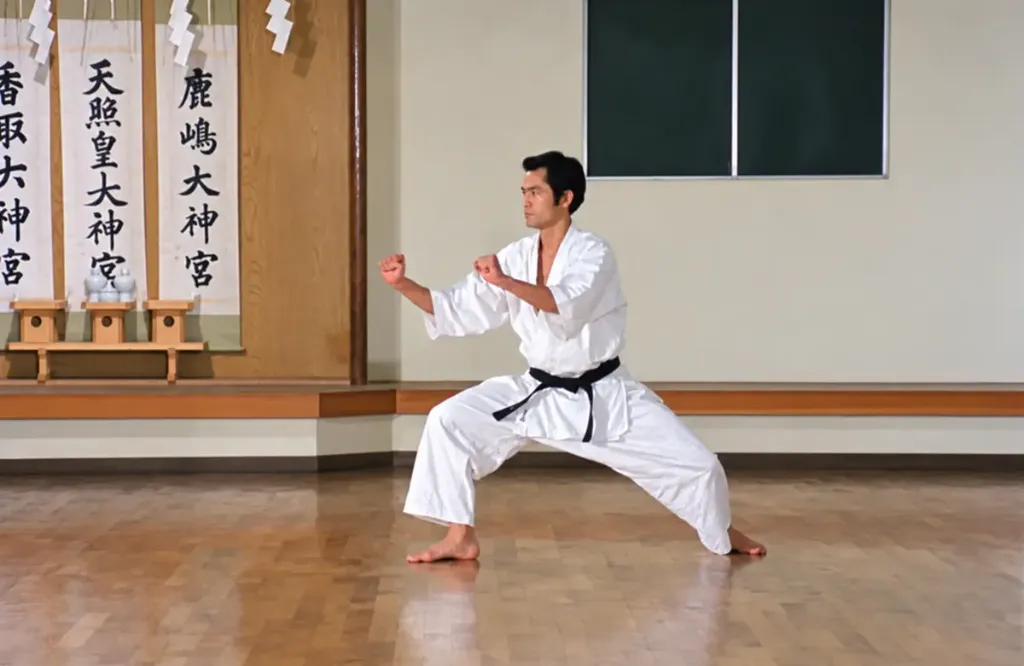 Master Tomoji Miyamoto in his prime at age 30, demonstrating the deep rootedness and relaxed extension of Shotokai during the 16mm kata filming project.
Both were clad in traditional Japanese Etchu fundoshi (linen loincloths). Looking at the young student standing tensely before him, Master Egami remarked with quiet surprise:
"You are young, yet you wear an Etchu loincloth?"
Desperately trying to blend in as an ordinary pilgrim tourist staying at the temple, Miyamoto blurted out an innocent "Yes, sir!" and quickly vanished into the night.
"Miyamoto in the Loincloth" and the Ideal Adult
The following morning came the mandatory freshman introduction ceremony. New club members were assembled in the master's hall to formally present themselves to the senior alumni and the Supreme Instructor.
Miyamoto huddled behind taller classmates, hoping his face would not be recognized in the daylight. But protocol required each freshman to step forward individually. When his turn arrived, Miyamoto stepped out, bowed deeply, and announced:
"My name is Tomotsugu Miyamoto, from Tokushima Prefecture. I joined the karate club because..."
Sitting serenely across the tatami beyond the row of senior alumni sat Master Egami. As Miyamoto spoke, the master's hands moved rhythmically in his lap. Unbeknownst to the students, Egami was an accomplished stenographer and habitually traced shorthand characters (sokki) with his fingers while listening.
When Miyamoto finished his formal introduction, Egami looked up, smiled warmly, and remarked to himself:
"Ah. So it is Miyamoto in the loincloth."
The surrounding seniors looked bewildered, having no idea what the master meant, while Miyamoto stood frozen, breaking out in a cold sweat. Egami chuckled gently: "So your name is Miyamoto."
That humorous connection broke through the rigid student hierarchy and opened the door to a lifelong bond. More profoundly, Master Egami's subsequent address to the young novices reshaped Miyamoto's entire understanding of karate:
"Some of you may have prior experience in karate; others encounter it for the first time at university. I have practiced karate for forty years. You may have preconceived ideas of what karate is, and you may feel bewildered by the difference between those expectations and what is practiced here. You might think, 'This is not what I want to do.' But after forty years, I feel I am only now approaching the ideal form of what true karate should be.
Please, just for the four years of your university life, let this old man trick you. Karate is not something that can be explained in words; it is something you must experience in your own body."
Listening to those words, Miyamoto looked closely at Master Egami. He saw a man possessing profound dignity, serene eyes, and a transcendent human beauty. "He was a true adult, an ideal human being," Miyamoto reflected decades later. "He embodied the image of the adult I wished to become. In that single moment, I decided: I will let myself be fooled. I am staying."
From that day forward, the grueling training ceased to be an obstacle. Following the summer camp, introduced by senior student Kengo Kunimitsu, Miyamoto began visiting the Egami residence regularly, welcome at all hours.
The Tragedies of 1968: Impermanence and a Solemn Vow
In 1968, as Miyamoto approached his final year at Chuo University, life dealt him a series of catastrophic personal blows that shattered all ordinary life plans.
In January 1968, his beloved 18-year-old younger brother, a generous young man known for giving his part-time earnings to friends in distress, tragically committed suicide. The trauma of identifying his younger brother's body at the police station seared itself permanently into Miyamoto's psyche.
Soon after, his nephew, an innocent fifth-grade elementary school student, contracted childhood cancer and passed away rapidly. Devastated by the loss of his son, Miyamoto's father fell ill and died shortly thereafter. Within a single year, three close family members vanished into the void.
To compound this grief, Miyamoto suffered an acute intestinal obstruction in the spring of that same year, requiring emergency abdominal surgery that incapacitated him for months and prevented him from regular dojo practice until the autumn.
Facing the sudden reality of death, Miyamoto was gripped by a deep awareness of mujo (universal impermanence):
"Young or old, none of us knows when we will die. Senior alumni approached me with lucrative job offers at prestigious corporations, telling me I would not even need to sit for entrance exams. But I felt deeply that I had little time left in this life. I turned down every offer. Instead, I immersed myself in religious and philosophical books, asking why we live, and preparing myself for whatever moment might come."
During those quiet autumn months, Miyamoto split his hours between solitary reading in the university library and training at the Chuo dojo. Observing his detachment from conventional career pursuits, Motonobu Hironishi (Genshin Hironishi), an influential leader of Shotokai, approached him with a proposal:
"I hear you are not seeking corporate employment, spending your days reading and training. If that is so, why not work at the newly established headquarters office of the Nihon Karate-do Shotokai?"
Around the same time, Master Egami had confided in Miyamoto his burning final wish: "I want to rebuild the Shotokan before I die."
For Miyamoto, the decision required no deliberation. "Above all else, I loved and admired Master Egami," he testified. "If my labor could bring joy to his heart and help realize his dream, I resolved without hesitation: I will dedicate my entire twenties to Master Egami."
Apprentice to the Master: Midnight Dialogues and the Egami Mirror
Working at the Shotokai headquarters, Miyamoto became Egami's close assistant and personal attendant, taking care of the master's daily personal needs. Master Egami possessed an extraordinary, magnetic charisma that drew people from all walks of life - artists, philosophers, traditional craftsmen, and martial artists. Those knowledgeable in traditional Chinese astrology (Four Pillars of Destiny) observed that Egami was born under the "Star of the Emperor," naturally standing at the center of human endeavor.
At regional gasshuku, Master Egami would engage his inner circle in profound discussions that stretched until two or three in the morning. As the director of training, Miyamoto was required to massage the master's aching back, wait until Egami fell peacefully asleep, and then rise at five in the morning to lead dawn practice.
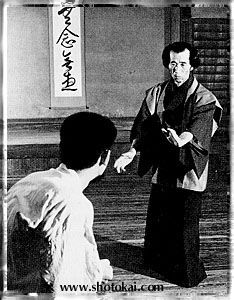 Master Shigeru Egami with close disciple Tomoji Miyamoto during technical research sessions in the 1970s.
On one occasion, after attending to Egami through the night without a single minute of sleep, Miyamoto marched furiously into the morning dojo, only to find the exhausted university students nodding off in seiza (kneeling posture). Enraged, Miyamoto subjected them to an intensely severe physical workout. Afterward, he reported to Egami: "The students were utterly pathetic this morning."
Master Egami smiled gently and replied:
"They were simply expressing your own internal state, Miyamoto. You were the sleepiest one in the dojo. What was inside you resonated directly in them."
The lesson struck Miyamoto like a thunderbolt. Master Egami did not teach martial arts through rigid dogma; he taught through transparent awareness, using the dojo as an uncompromising mirror of the human spirit.
The Evolution into Budo: Iaido, Tai Chi, and Eastern Health
Master Miyamoto's apprenticeship with Egami laid the technical and spiritual foundation for a distinguished lifetime of scholarship and budo mastery. In 1976, when Master Egami published his definitive masterpiece The Way of Karate: Beyond Technique, it was Tomoji Miyamoto who posed for virtually every technical photograph in the volume, illustrating the grounded stances, penetrating strikes, and supple deflections of orthodox Shotokai.
Recognizing that Master Egami's karate touched the deepest universal laws of Eastern movement, Miyamoto expanded his lifelong research into allied martial traditions:
- Iaido (Swordsmanship): He studied Muso Jikiden Eishin-ryu Iaido under Master Hisao Takeshima (Daiun), the 20th Sōke (宗家) of the Tosa Eishin-ryu lineage, mastering the razor-sharp timing, intention (seme), and spatial awareness of classical Japanese swordsmanship.
- Wu-Style Tai Chi Chuan: He became a personal disciple of Master Ma Changxun, the revered 5th-generation successor of traditional Wu-style Tai Chi Chuan, delving deeply into internal power (jin), yielding deflection (hua), and the subtle neutralization of external force.
- Academic and Physical Education Leadership: Miyamoto dedicated his academic career to Chuo University, serving as Full Professor, Director of the Chuo University Institute of Health and Physical Education, and Visiting Professor at Tsinghua University in Beijing.
Today, as head of the Yuten Karate Miyamoto Dojo and a leading director across national martial arts and health federations, Master Tomoji Miyamoto preserves Master Shigeru Egami's legacy not as a frozen museum piece, but as a living, breathing art of self-knowledge and compassion.
Archival Citation & References
This biographical article is synthesized from the official historical interview:
- Source: "My Teacher, Shigeru Egami" (Part 1: The Ideal Adult, July 17, 2018; Part 2: The Meaning of 'A Starting Point', August 1, 2018).
- Publication: Co2 / Kotsu Editorial Department (
ko2.tokyo), Tokyo, Japan. - Occasion: Commemorating the official release of Master Shigeru Egami's archival monograph and DVD Karate-do Kata Textbook (July 11, 2018).
- Participants: Narrated by Master Tomotsugu (Tomoji) Miyamoto; special cooperation by Ken Egami.
- Additional Archival Context: Chiyoko Egami, Kimikagesō (Memoirs of the Egami Household, Tokyo, 1991); Shigeru Egami, The Way of Karate: Beyond Technique (Kodansha International, 1976).