The Household in Magome: Life with Master Shigeru Egami
Life in Magome, postwar hardship, and Master Egami's dedication to his students
One of the most moving aspects of Kimikagesō is the vast distance between Shigeru Egami at home and Shigeru Egami in the dojo. In domestic matters, Egami was completely detached. Confronted with household bills, scarce groceries, or family dilemmas, he would calmly answer: "I haven't heard anything about that" or "I forgot" (Chapter 66).
Faced with Chiyoko's desperation, he brushed off decisions with a dry "Manage it yourself", leaving her entirely responsible for feeding and raising three children through the harsh postwar years. When Chiyoko suffered a high fever during her first pregnancy, Egami dropped her at the hospital doors and continued to his office, until an enraged doctor telephoned him to reprimand him for abandoning his wife.
Yet the moment a karate student knocked on their modest front door in Magome (Ota-ku, Tokyo), that tired, forgetful man vanished. His posture straightened, his eyes lit up, and his memory returned completely. He would sit on the tatami until two or three in the morning, demonstrating wrist turns, explaining hip mechanics, and recounting old stories of the masters with boundless patience.
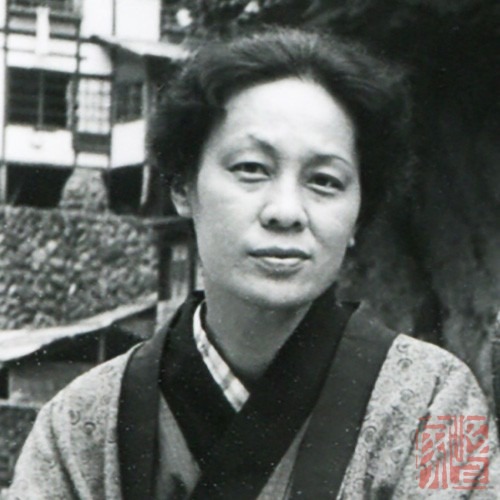
Chiyoko Egami (1920-1991)
Author of the Kimikagesō memoirs. Married to Shigeru Egami in an arranged match in 1941, she sustained for forty years a household that welcomed and nurtured hundreds of Shotokai practitioners from Japan and abroad.
National Diet Library of Japan (NDL) Catalog Record • Tokyo.
Welcoming Disciples: The Extended Household
Egami adamantly refused to turn Karate-do into a commercial enterprise or profitable commodity. He never charged commercial tuition fees nor accepted sponsorships that would compromise the sincerity of his art. Consequently, the economic strain fell squarely on Chiyoko.
Despite tight resources, their home in Magome embraced devoted disciples like family. Several students lived in the Egami household as uchideshi (live-in disciples), including Hiroyuki Aoki during his university years, and later Isao Ariga and Masayuki Nakano, who resided in the house during Egami's final five years (with Nakano staying on for another five years following the master's passing). Other close disciples, including Chuo University captain Yoshinori Takita, Tomoji Miyamoto, Fumito Sugimoto, and a young Atsuo Hiruma, always found in Chiyoko a warm matriarchal presence who served tea, washed keikogis, and listened to their personal hopes.
Kimikagesō proves that Shotokai was not forged solely by technique on the dojo floor, but through the quiet dedication and sacrifice of a remarkable woman.
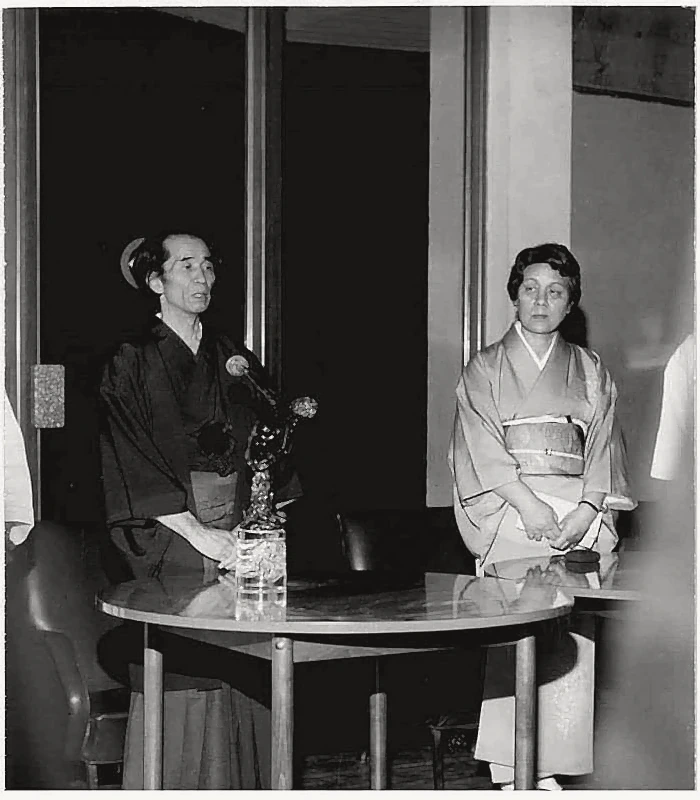
Master Shigeru Egami & Chiyoko Egami: Formal Gathering
A rare formal photograph documenting Master Shigeru Egami in dark haori and Chiyoko Egami in traditional silk kimono attending an official budo reception. While Master Egami led the spiritual and technical direction of Shotokai, Chiyoko sustained the domestic sanctuary in Magome that welcomed generations of students from Japan and around the world.
Kimikagesō Archival Collection • Tokyo, Japan.