Strength Born of Frailty: Surgeries, Weakness, and the Discovery of Non-Contraction
Transcending the makiwara, penetrating shock, and the physics of non-contraction
The global popularity of Karate-do in the mid-twentieth century was anchored in the demonstration of destructive power: board breaking, brick smashing, and the instantaneous muscular clenching known as kime (極め). Shigeru Egami had mastered this heavy style in his youth. Serving as Yoshitaka Funakoshi's daily sparring partner, he threw himself into brutal makiwara conditioning and ferocious full-contact exchanges.
Yet the physical toll was devastating. In 1955, Egami suffered severe gastric complications that required two life-threatening operations within months, removing part of his stomach. His weight plummeted to 37 kilograms (81 pounds). He was physically shattered, unable to lift heavy objects or clench his muscles without unbearable pain.
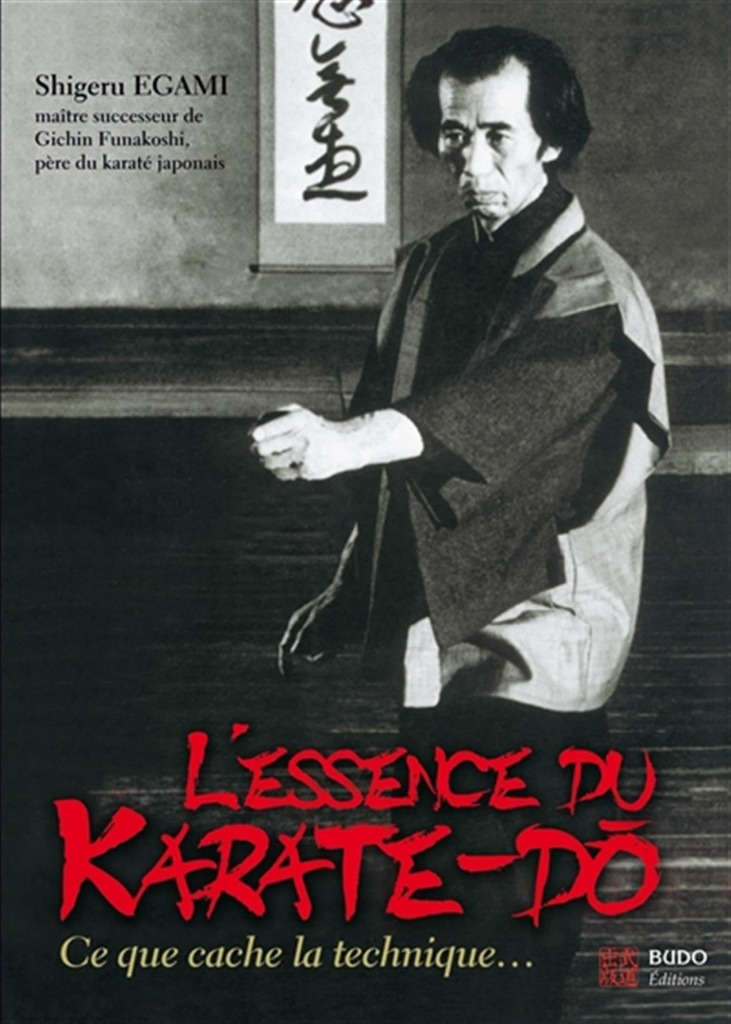
Master Shigeru Egami (1912-1981)
Following his 1955 surgeries, Egami discovered that muscular clenching hardens the surface but arrests the shockwave, whereas an entirely relaxed body acts like a hydraulic whip, transferring kinetic power straight through to the internal organs.
Shotokai.com Central Archives • Tokyo, Japan.
The Non-Contraction Breakthrough (1955-1958)
Forced to strike without brute muscular force, Egami began experimenting on receptive senior students and university practitioners between 1955 and 1958. Around 1957-1958, he definitively abandoned the rigid makiwara post. What he discovered transformed Shotokai:
- When a fist is clenched hard upon impact, the shock bounces off the opponent's muscular surface, causing bruising without displacing their center of mass.
- When a strike is launched with absolute physical relaxation (shizen-tai), dropping the shoulders and loosening the hand until the final fraction of an inch, energy travels like a liquid shock wave, penetrating deep into internal organs and sending the partner reeling backwards.
This research birthed what Japanese martial arts circles called the "Funakoshi-Egami Style", defined by long supple stances, soft arms, and the pursuit of spiritual unity (Heiho) rather than athletic sport competition.
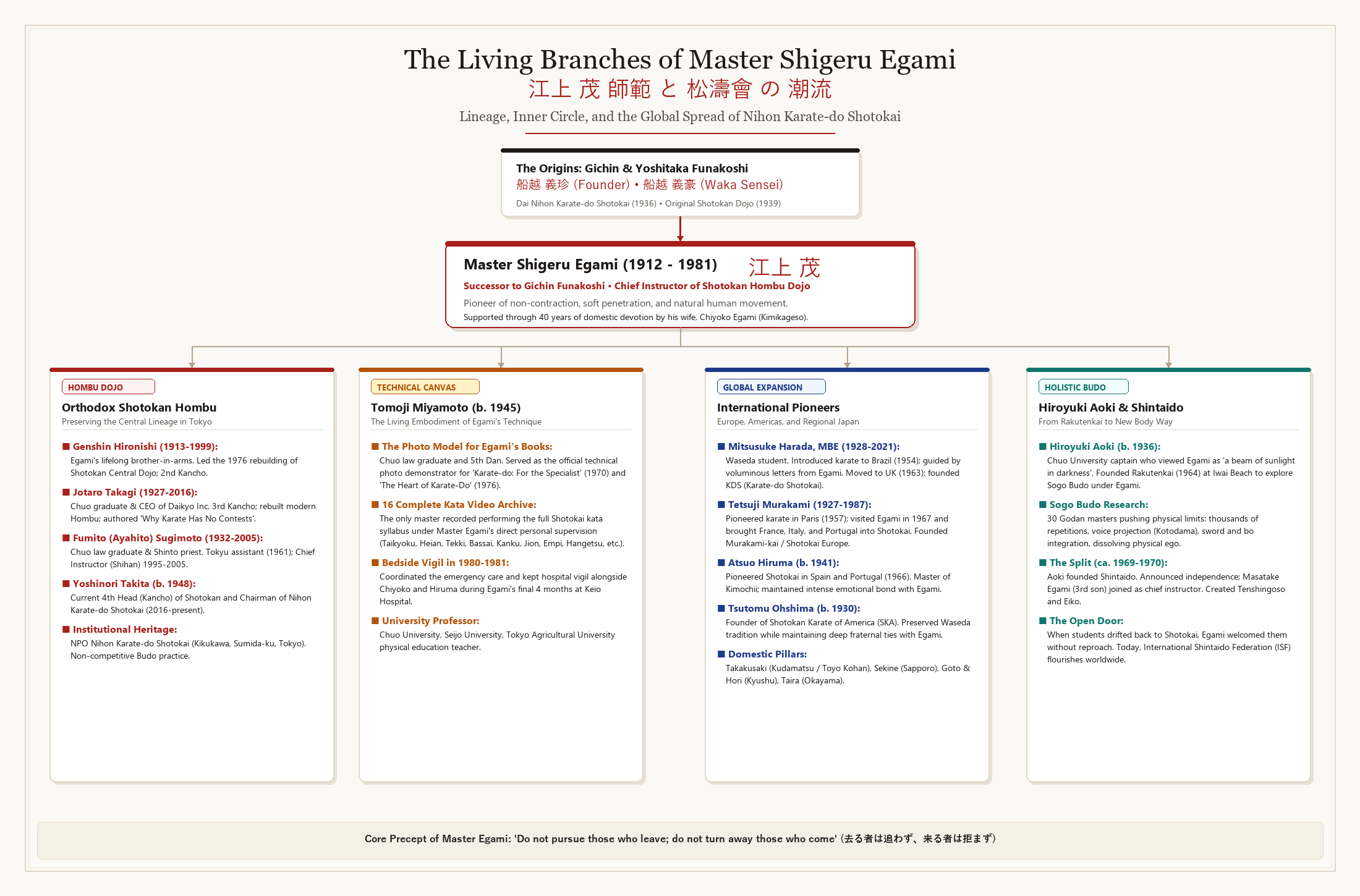
Historical Diagram: The Living Branches of Master Shigeru Egami
去る者は追わず、来る者は拒まずThe evolution of Egami's karate toward non-contraction and its divergence into traditional Shotokai and Hiroyuki Aoki's Sōgōbūdō / Shintaido.