I. The Common Origin: Gichin & Yoshitaka Funakoshi
At the apex of twentieth-century Karate-do stands the foundational partnership of Master Gichin Funakoshi (1868-1957) and his dynamic third son, Yoshitaka "Gigō" Funakoshi (1906-1945). With the formal establishment of the Dai Nihon Karate-do Shotokai in 1936 and the construction of the original Shotokan dojo in Mejiro (1939), Yoshitaka instituted radical technical reforms: lower stances, extended lunging attacks (oi-zuki), and modern dynamic kicking methods (yoko-geri, mawashi-geri, ushiro-geri).
Refining this ferocious physical curriculum required a daily sparring counterpart capable of absorbing terrifying impact. That partner was the young Waseda University champion Shigeru Egami, who threw himself into unyielding daily training.
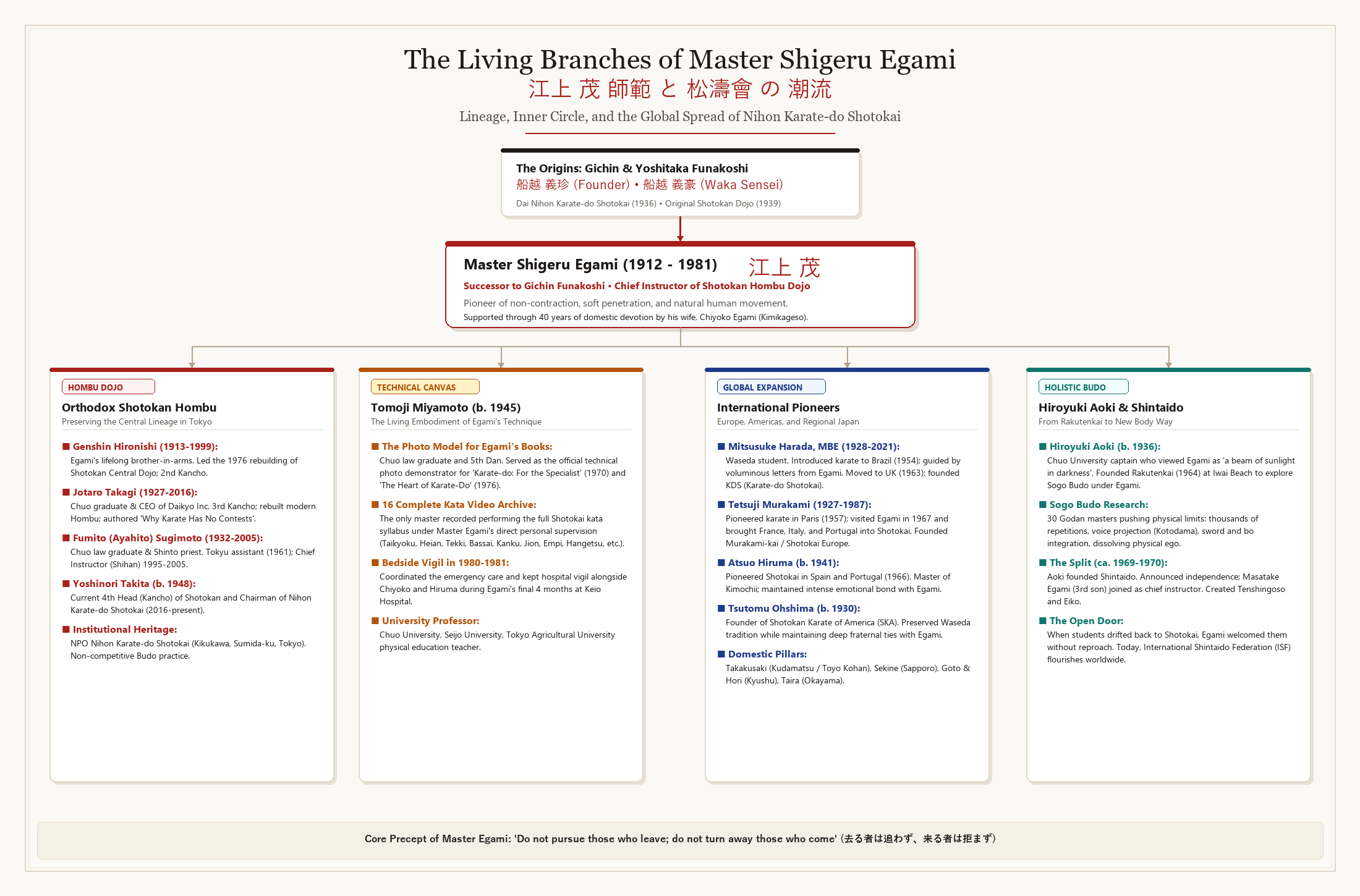
II. The Central Pillar: Master Shigeru Egami (1912-1981)
Appointed by Gichin Funakoshi as his technical successor and Chief Instructor (Shihan) of the Shotokan, Egami experienced an extraordinary biomechanical epiphany. In 1956 and 1957, following two life-threatening gastric operations that reduced his body weight to 37 kilograms (81 pounds), Egami realized that muscular clenching (kime) hardens the surface but arrests the shockwave, whereas complete relaxation (mukin) permits kinetic energy to penetrate deeply into the vital organs.
Egami's technical experiments, his dojo instruction, and his relationships with senior disciples during these critical decades are documented firsthand in the archival memoir Kimikagesō (1991).
III. Branch 1: Orthodox Shotokan Hombu (Tokyo)
Safeguarding the central headquarters dojo and orthodox non-competitive practice fell to Egami's senior institutional allies:
- Genshin (Motonobu) Hironishi (1913-1999): Lifelong brother-in-arms from Waseda, 2nd President of Shotokai, and author of Why Karate Has No Contests. Presided over the rebuilding of the Central Shotokan Dojo in 1976.
- Jotaro Takagi (1927-2016): Chuo law graduate and corporate CEO of Daikyo Inc., 3rd Kancho, who financed and constructed the modern Tokyo headquarters in Kikukawa, Sumida-ku in 1995.
- Fumito (Ayahito) Sugimoto (1932-2005): Chuo graduate and Shinto priest, Chief Instructor (Shihan) from 1995 to 2005, embodying moral purity.
- Yoshinori Takita (b. 1945): 4th Kancho and current President of Nihon Karate-do Shotokai. Chuo captain who oversaw the 2023 international volume There Is No First Strike in Karate-do, guiding over 40 dojos across Japan and worldwide.
IV. Branch 2: The Technical Canvas • Sensei Tomoji Miyamoto
Sensei Tomoji Miyamoto (b. 1946) became the living physical canvas for Egami's mature technique. A Chuo law graduate and 5th Dan, Miyamoto was chosen personally by Egami as the primary photographic demonstrator for his definitive 1976 volume, The Way of Karate: Beyond Technique (later published as The Heart of Karate-Do), following the 1970 Karate-do: For the Specialist where Hiroyuki Aoki and Rakutenkai members served as models.
In the mid-1970s, Miyamoto demonstrated the full 16-kata film archive introduced on camera by Master Egami. When Egami fell critically ill in 1980, Miyamoto coordinated hospital care and kept daily bedside vigil alongside Chiyoko at Keio Hospital until Egami's final breath in January 1981.
V. Branch 3: International Pioneers & Regional Pillars
Egami's revolutionary soft karate spread across the globe through remarkable emissaries:
- Mitsusuke Harada MBE (1928-2021): Waseda disciple who introduced karate to Brazil (1954) and moved to the UK (1963), founding KDS (Karate-do Shotokai) guided by voluminous letters from Egami.
- Tetsuji Murakami (1927-1987): Pioneer in Paris from 1957. In 1967 he visited Egami in Tokyo, immediately adopted non-contraction, and formed Murakami-kai / Shotokai Europe.
- Atsuo Hiruma (b. 1941): Disciple from age fifteen and Hosei University economics graduate. Arrived in Spain in 1966 as the first Japanese Karate master in the country. In 1983 he founded the Madrid Honbu Dojo, serving as N.K.S. Delegate for Europe.
- Tsutomu Ohshima (b. 1930): Founder of Shotokan Karate of America (SKA) in 1956, preserving traditional Waseda roots while maintaining fraternal bonds with Egami.
- Regional Japanese Pillars: Takakusaki (Kudamatsu / Toyo Kohan), Sekine (Sapporo), Goto & Hori (Kyushu), Taira (Okayama).
VI. Branch 4: Holistic Budo & the Shintaido Divergence
In 1964, observing the rigid limitations of university club hazing, Chuo captain Hiroyuki Aoki (b. 1936) formed the elite research group Rakutenkai at Iwai Beach with Egami's blessing. Approximately thirty Godan black belts researched voice projection (Kotodama), classical sword (Kenjutsu), and extreme endurance to dissolve muscular resistance.
Around 1970, Aoki announced independence to establish Shintaido (New Body Way). Egami's third son, Masatake Egami, joined as chief instructor. Rather than condemning the schism, Master Egami welcomed departing and returning practitioners alike with his open-door precept: "Do not pursue those who leave; do not turn away those who come."